Axal accounts are self-custodial: you alone control your private key, and Axal automates yield strategies on your behalf within strict, verifiable limits. This page explains how the wallet is created, how it gains smart-account capabilities when needed, and how Axal signs transactions on your behalf securely.
How your wallet is created
Privy is the wallet infrastructure embedded inside Axal — the secure plumbing that lets you use the app without installing a browser extension or juggling seed phrases. Privy spins up a self-custodial wallet the moment you sign in (with email, passkey, or an external wallet). You alone control that wallet's private key; neither Axal nor Privy can touch your funds.
- Withdrawal Options: You can export your wallet's private key or seed phrase at any time through your account settings — see Export your wallet
- Standard Compatibility: Withdrawn wallets are fully compatible with any standard Ethereum wallet like MetaMask, Rainbow, or hardware wallets
- No Lock-In: Your funds are never tied to the Axal platform — you can access them directly through any compatible wallet
- Persistent Access: Even if Axal were to shut down, you would still have full access to your funds through your withdrawn wallet credentials
Smart account capabilities with EIP-7702
Your Axal wallet follows the ERC-7702 standard, which lets a standard key-controlled account adopt smart-account behavior on demand. Your account behaves like a normal wallet by default; when advanced features are needed, the wallet adds a short-lived authorization that lets your account execute code for that action, then returns to normal once the action completes.
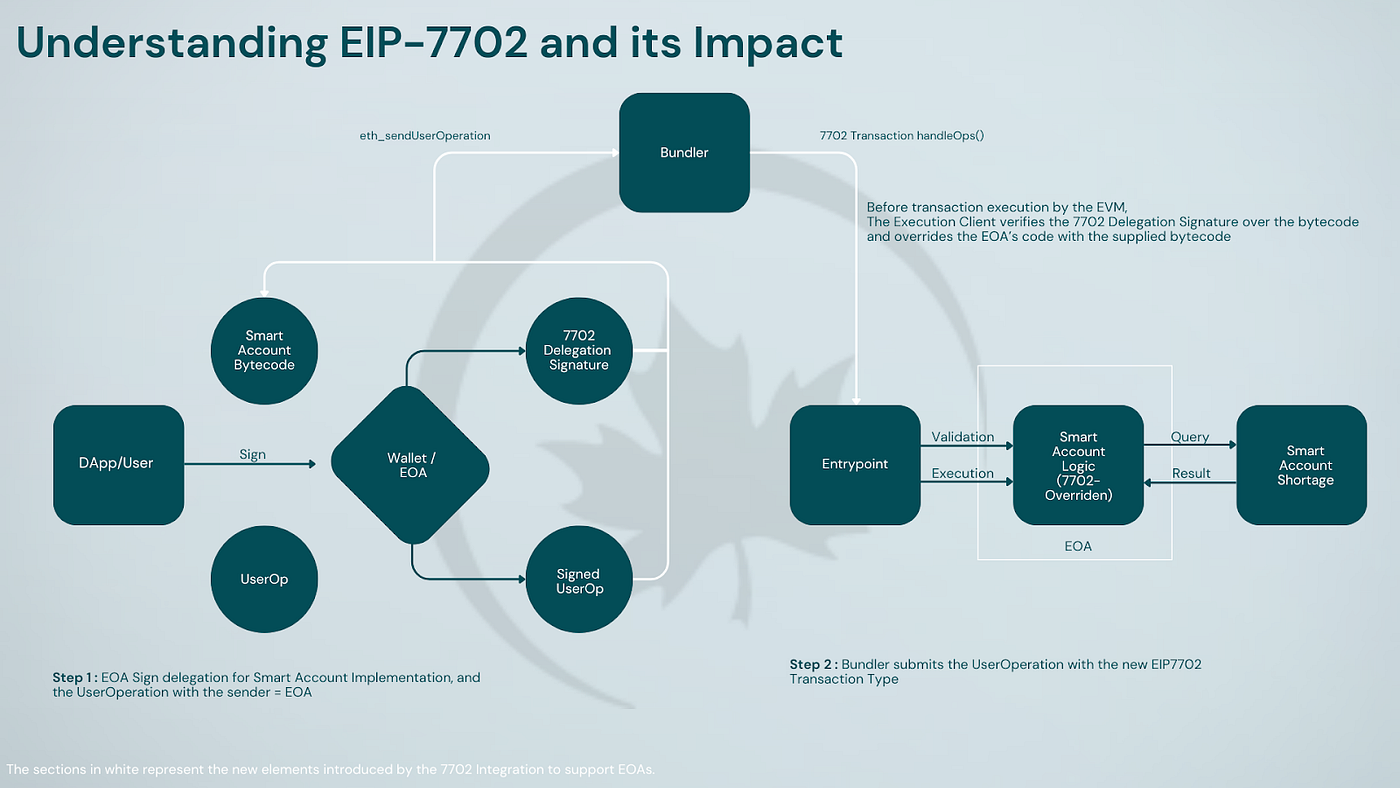
How it works at a glance:
- Normal state: your account acts like any other standard wallet.
- Upgrade step: your wallet sends a transaction that includes an authorization referencing code to run.
- Enhanced state: your account can validate and execute advanced logic for that action.
- Back to normal: once done, the account returns to standard behavior.
This is what powers:
- Gasless transactions: Deposits and withdrawals happen without you needing to manage gas fees
- Batched, automated operations: Axal routes your capital across lending protocols and rebalances positions without requiring you to sign or approve each move
- No separate contract deployment: advanced features turn on only when needed, avoiding always-on overhead
You can read more about the underlying standard:
Account abstraction for Autopilot
For Autopilot specifically, Axal also leverages Alchemy's ERC-4337 smart contract wallets on top of the same Privy authentication foundation, enabling:
- Automatic Gas Sponsorship — execute transactions and interact with DeFi protocols without needing ETH for gas
- Batched Transactions — execute multiple DeFi operations in a single confirmation, reducing approval prompts
- Scheduled Operations — time-based triggers for portfolio management, enabling true "set and forget" management
- Security Guardrails — per-session/per-app spending limits, time-locks for large withdrawals, and recovery mechanisms beyond seed phrases
Behind the scenes, this smart contract wallet is fully controlled by your private key (via Privy), executes bundled transactions through a bundler, and lets gas be paid by a separate sponsoring account — all while keeping custody with you.
Trusted Execution Environments (TEEs)
Axal uses Trusted Execution Environments — the same class of technology behind Face ID and passkeys — to protect your keys and to ensure nobody at Axal, including Axal staff, can tamper with signing software or access your keys, even for debugging.
- Isolated Processing: Keys are generated and stored in hardware-level isolated environments, separated from the main operating system
- Encrypted Memory: Keys are processed in encrypted memory regions inaccessible to any external process
- Zero Knowledge Design: Neither Axal nor Privy staff can ever access your keys
Specifically, Axal uses AWS Nitro Enclaves to run its signing software — a tamper-proof, fully encrypted environment nobody can look into. The TEE also provides attestations: cryptographic signatures that prove the code running inside the TEE is exactly the code Axal says it is. Example attestation:
{
  "Measurements": {
    "HashAlgorithm": "Sha384 { ... }",
    "PCR0": "7fb5c55bc2ecbb68ed99a13d7122abfc0666b926a79d5379bc58b9445c84217f59cfdd36c08b2c79552928702efe23e4",
    "PCR1": "235c9e6050abf6b993c915505f3220e2d82b51aff830ad14cbecc2eec1bf0b4ae749d311c663f464cde9f718acca5286",
    "PCR2": "0f0ac32c300289e872e6ac4d19b0b5ac4a9b020c98295643ff3978610750ce6a86f7edff24e3c0a4a445f2ff8a9ea79d"
  }
}
The PCR2 field is a hash of the binary running inside the TEE. Anyone can build our signer code and generate their own attestation to verify it matches — we've open sourced our signer codebase so this can be independently checked.
Verified signing & delegated actions
Axal carries out onchain actions on your behalf through a verified signer: software between Axal's servers and Privy's servers that checks every transaction against a policy before it's allowed to sign. Currently these rules are fixed by Axal (for example, "only deposit to pools with 7D APY greater than 5%"); user-specified rules are coming soon.
Delegated signing is used for exactly two purposes:
- Rebalancing your portfolio to maintain the best return
- Panic exiting your positions if malicious behavior is detected in any supported pool
Axal never sees your private keys — delegated signing requests to Privy are executed inside a TEE over HTTPS, so neither Axal nor an attacker can observe them. Today, the verification layer enforces a whitelist of pools you can interact with plus withdrawals to your own address only; broader user-defined policies are planned.
Self-custody, in short
- Your wallet is non-custodial through Privy smart wallets — you remain in control
- Security policies are enforced with TEE-based checks
- Sensitive actions can require additional approval, such as two-factor authentication
- Keep your private key and recovery phrase safe and offline when possible, enable two-factor authentication, and review transaction details before approving